|
[GERMANIC
MYTHOLOGY][CLASSIC
ILLUSTRATIONS]
|
|
|
|
|
|
From 1874 to 1877, renowned artist Mortiz Schwind's favorite pupil,
Dr. Julius Naue of Munich, completed a series of frescos
titled
Das Schicksal der Götter nach der Deutschen Heldensage
("The Fate of the Gods from the German Hero-saga")
in the private home of
wealthy merchant, art collector and politician
Arnold Otto Meyer,
depicting the lives
of the Germanic gods from their beginning to their end on the
interior walls of Meyer's Hamburg home. The
fresco-cycle consisted of 11
sections with
illuminated lunettes (stichkappes)
and spandrels
(zwickels)
overtop the main frescos.
Dr. Naue began the work
during his stay
in
Rome in 1874,
then realized in it in 1877
in the home and art showcase of
Arnold
Otto
Meyer.
Although only one photograph of the freize
as been identified to date and
the work itself is lost, Professor Naue's fresco cycle
can be reimagined with the help of contemporary
newspaper sketches from 1880 and a detailed description
of it in 1891, (see below). |
|
|
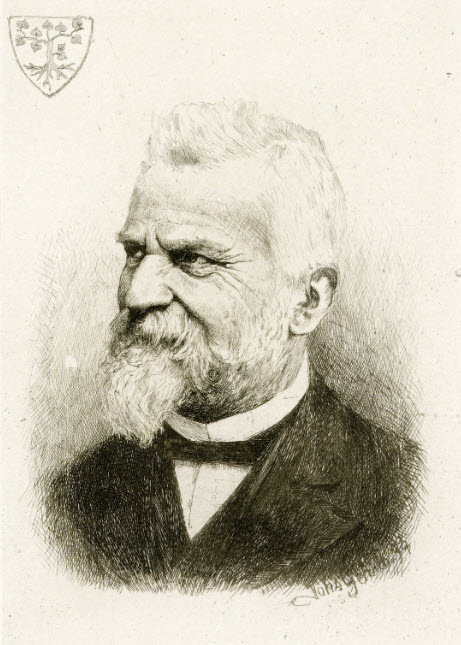
ARNOLD OTTO MEYER (1825-1913)
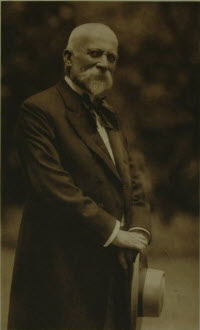
Arnold Otto Meyer
1905
|
Arnold
Otto Meyer was born into a respected Hamburg
family of merchants on September 1st, 1825. His father Georg Christian Lorenz
Meyer (1787–1866) was the son of Hamburg wine
merchant, senator, and art collector Johann Valentin
Meyer (1745–1811). Like his father and grandfather
before him, Otto Meyer was destined for a career in
commerce. The family firm Meyer & Co., engaged in
overseas trade. Otto Meyer himself spent many years in
Singapore, where he served as company consul for Hamburg
and Prussia. After his return to Hamburg, he took his
father’s place and successfully expanded the firm.
His grandfather, the Hamburg senator Johann Valentin
Meyer, was an avid art collector and passed his
collection down to his heirs. What the grandfather
began, the grandson continued. An innate affection for
art was part of his family legacy. He took this rich
inheritance from his grandfather and grew it into a
famous collection, which comprised almost all the
important German masters of his time.
A.
Otto Meyer
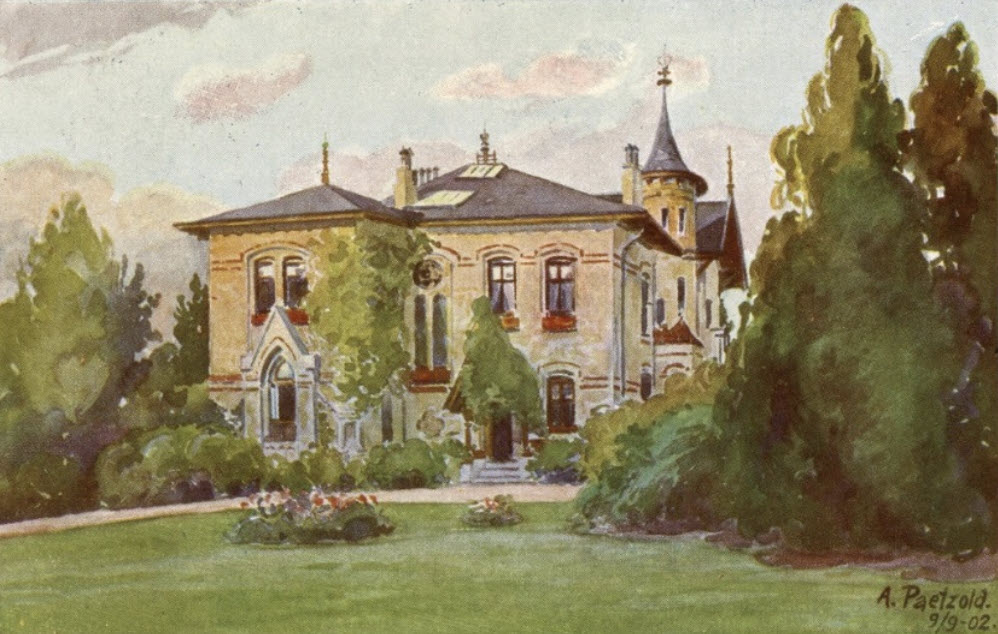
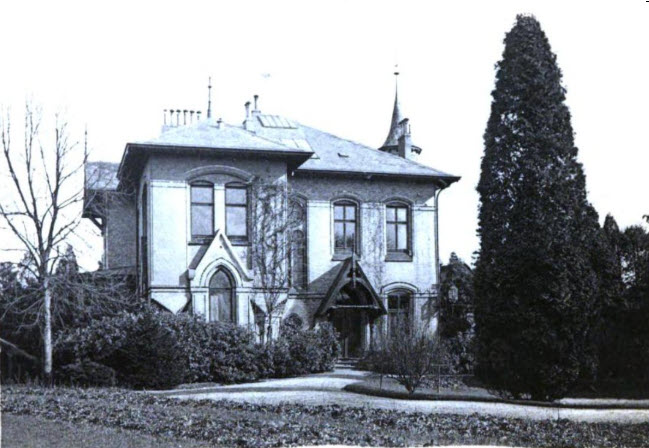
had the house Hauhoppen built in 1872/73. It lay
in the midst of a large park and was executed in the
Neo‑Gothic style, with wooden ceilings and stone vaults,
as well as wall
paneling with cabinets for the reception of its owner's
valuable collections.
Its essential charm lay
in the ceiling paintings and embroidered wall tapestries
by Hermann Schmidt (Hamburg); the wall friezes by Dr. Julius
Naue, Carl and Johannes Gehrts, and the older Friedrich
Preller; furniture by Bichweiler; and
colored glass windows in the hall and on the staircase
by Brünner (Hamburg).
Haus
Hauhopen in Othmarschen suited its owner's artistic
inclinations and was accordingly impractical.
The country home (Landhaus)
held an imposing
collection of
art, paintings, graphics and
drawings
by artists of the 18th
century from the collection of his grandfather which he had inherited, as
well as
works by contemporary
19th
century
artists, whom he knew personally, including Johann Friedrich Overbeck,
Phillip Veit, Josef Ritter von Führich, Camillo Genelli,
Joseph Anton Koch,
Johann Christian Reinhart Reinhard, Friedrich Preller [painter of the Odyssee-Zyklus], Ludwig Richter,
Karl Gottlieb Peschel, Christian Ernst
Bernhard Morgenstern,
Julius Schnorr von Carolsfeld,
Jacob
Gunther, Martin Gensler, Charles and John Gehrts, Julius
Naue, Eugen Nepoleon Neureuther, Anselm Feuerbach, and
Moritz von Schwind.
He kept whole volumes, each of which was dedicated to an
artist. At the time of Schwind's death, Meyer had over 200 of his
drawings.
Die Haus Hauhopen at Wrangelstrasse 20,
Hamburg-Othmarschen was built in 1872-1873 by
architect
L. H. M. Breckelbaum of yellow Rüdersdorfer
limestone in Gothic-style for wealthy merchant and
art collector Arnold Otto Meyer. The doors, stairs
and ceilings were careful reproductions of Italian
prototypes. He had embroidered carpets hung at the
height of the parapet for his wall and ceiling
murals of a festival. The stained glass windows in
the hall and on the staircase were copies from his
collection. Particularly noteworthy was the great
hall, whose walls were decorated with scenes from
Norse mythology.
|
Meyer
was a sociable man and loved to entertain. The household
consisted of him and his wife Luise Caroline neé Ferber
(1833-1907) and their five children, daughters
Magdalena, Helene Emilie, Luise Emerentia, and Meta
Sophie Emerita, as well as their eldest son Eduard
Lorenz. The family lived in the Villa Hauhopen in
Hamburg-Othmarschen, Heubergskamp and at
Ernst-Merck-Straße 5. There were always friends and
artists about. In the early 21st century, a diary dated
1879-1884 handwritten by Arnold Otto Meyer's daughter
Emerentia (born October 21, 1861 in Hamburg; died 1944)
was put up for auction, but she wrote very sporadically
and only briefly in her diary during her time at Haus
Hauhopen.
The same cannot be said of her little sister,
Meta, who also wrote of her time there.
|
|
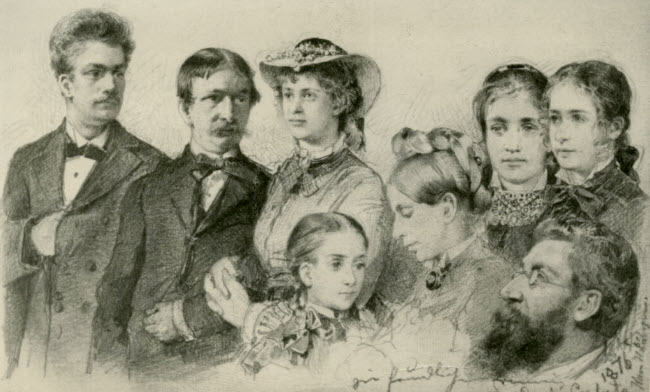
The A.O. Meyer Family
Carl Gerhts 1876
|
|
From a young age, her father's artistic sensibility and
his extensive art collection made a deep impression on
Meyer’s youngest daughter Meta, later the wife of the
Altona senator Alexander Baur (1866–1909). She recalled,
"His sense of beauty was so pronounced that as children
we never saw an ugly picture or heard an unpleasant
word. Picture books like Struwwelpeter or other
caricatures were strictly forbidden." His guiding
principle was: "Only the best is good enough for
children." He placed in our hands the charming woodcuts
of Ludwig Richter, the superbly drawn 'Münchner
Bilderbogen' —including quite a number by Moritz von
Schwind—and illustrations of costumes and traditional
dress from every century; we were allowed to color these
pictures, and he provided the instruction himself, just
as in later years he was the driving force behind our
drawing from nature." When her father’s art
collection had to be auctioned after his death, Meta
Baur wrote the following verses in the auction catalog:
|
|
|
»Zieht nun, ihr geliebten
Bilder,
Weit in alle Welt –
Meinem Herzen bleibt ihr ewig
Mehr, als alles Geld!
Ja! ihr waret edler Samen,
Früh schon ausgestreut,
Samen für die Kinderherzen,
Der sich stets erneut.
Nun in deinen Kindeskindern,
Liebster Vater mein,
Was du säetest wird ein Segen
Für die Deinen sein«
|
“Go now, beloved Pictures,
wide in all the world—
In my heart you will remain forever.
More than all the money!
Yes, you were noble seed,
scattered early on,
Seed for the children’s hearts
that always renews.
Now in your children’s children,
my dearest father,
What you sowed will become
a blessing of your own." |
| |
|
|
|
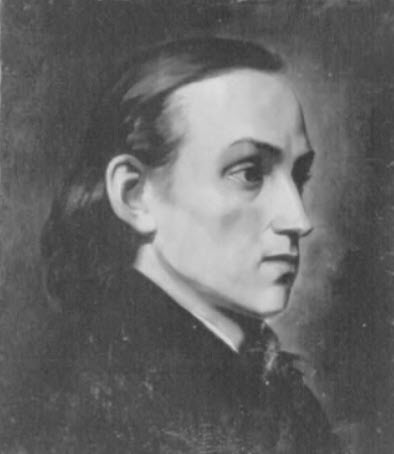
Professor Julius Naue |
Haus Hauhopen |
Arnold Otto Meyer
1894 |
| |
The house sits on land
sloping downward to the Elbe in the front
(waterside).
Thus the house is two stories in back
(streetside) and three in front.
|
|
|
|
After Meyer’s death on March 12th, 1913, his collection
of nineteenth-century German art was sold at auction by
C.G.Boerner, Leipzig, on March 16-20, 1914 in 870 lots.
A catalog of his extensive sketch collection was
published as
Handzeichnungssammlung Arnold Otto Meyer, Hamburg, I-II. Additional
information was printed in the
LeClaire Art Catalog. Initially,
the Hauhopen estate remained in possession of the
family, but was sold to the city of Altona in 1923 and
used as an administrative building. The
house was demolished in 1936 to make way for new
residental homes. The artistic interior furnishings are lost,
though some pieces from the Meyer family’s possessions
are now held in the Altona Museum.
In August 1942, the
Köthen Historical Museum records the purchase of the
wall frieze, "Fate of the Gods" by Julius Naue,
consisting of 6 large-format cartoons, created
between 1875 and 1877 for the villa of Arnold Otto Meyer
in Hamburg, from
Hubert Stierling,
the then-director of the Altona Museum, through
Leipzig art dealer Curt Naubert.
(It's possible that these cartoons hung in the villa
rather than the planned murals.) However, their
whereabouts today are unknown, and it's speculated these
cartoons were lost in storage during World War II.
The Meyer villa in
Othmarschen was located near the Elbchaussee
along the Elbe river. In 1872, Wrangelstrasse had
recently been cut across the northern paddocks of the
Böhl–Struve–Nölting estate, allowing the land to
transform from rural estates into the first wave of
merchant villas. Wrangelstrasse was laid out as part of
the early villa expansion west of Altona, but still
bordered open paddocks, orchards, and marshy lowland
along the Elbe. Parcels were large and intended for
single villas with private parks.
Othmarschen began as a
marshland fishing village (“Ottsmarsch”) on the Elbe
river. Historically, the region belonged to
Denmark who gave it its independence in 1664. When
Prussia and Austria defeated Denmark in the
German-Danish War of 1864, Altona became part of the
Prussian province of Schleswig-Holstein. Under
Prussian rule, the Danish border town developed into a
major industrial and railway center. The Meyers' home
Hauhopen sparked the transformation of Othmarschen into an elite villa
district. The surrounding meadows were subdivided into
villa parcels and other merchant families followed their
example, so that Wrangelstraße became a prestige
address by the late 1870s.
In 1938, the city of Hamburg was expanded to include
Othmarschen and the surrounding areas under the Greater
Hamburg Act (Groß-Hamburg-Gesetz) of 1937. At that time,
Wrangelstrasse in the Elbe village of Othmarschen was
incorporated into Hamburg and renamed Liebermannstrasse
after 1947.
|
|
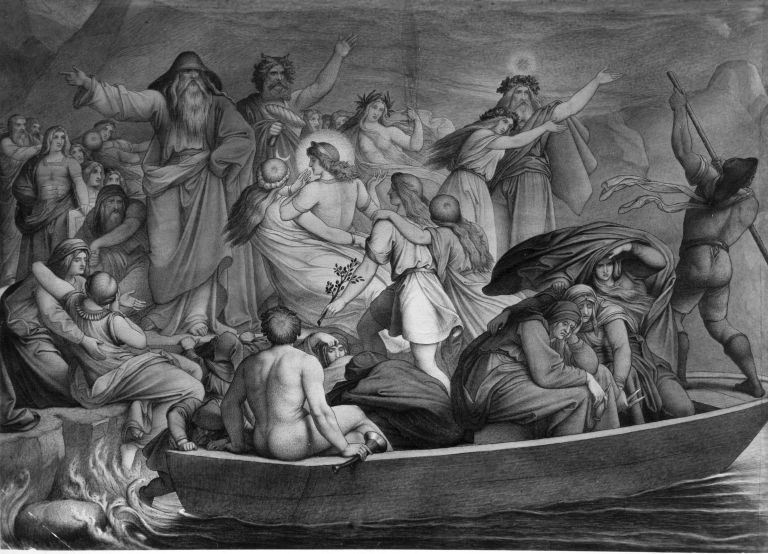
Julius Naue, The Nordic Gods,
Bavarian State Painting
Collections
Neue Pinakothek Munich
same as
Lenbachhaus Collection
Szene aus der germanischen
Göttersage, 1867
Inventory Card G 13058
|
|
Julius,
Naue, born at Köthen on 17 June 1835,
first
studied at the Nuremberg art school under August von Kreling,
then since 1861 in Munich with Moritz von Schwind, whose
pupil and assistant he was for six years. Naue, who made
a journey to Italy, had taken
particular interest in
German history and mythology, which he frequently
depicted in cyclical representations and 'cartoons' as
well as in watercolor and in fresco. In 1887, the
University of Tübingen appointed him Doctor of
Philosophy honoris causa.
Between 1875 and 1877, the painter Professor Julius Naue of
Munich executed a pictorial cycle, portraying the life
of the Germanic gods from their beginning to their end and
re-emergence.
The fresco cycle itself
is lost. Only one known photo of it have been identified
to date. The following contemporary descriptions and sketches are intended
to evoke Naue's illustrated mythic epic.
In 1880,
The Illustrated Newspaper (Illustrirte
Zeitung bd.74, nr. 1918, pp. 283-286) in an article
titled Das Schicksal der Götter. Deutsche
Göttersage. Ein Bildercyclus von Julius Naue
published a series of sketches of the work by Karl
Albert Regnet, representing about two-thirds of the whole
fresco-cycle. The first published segment clearly is a
continuation of the panel before, suggesting that Regnet
drew the entire cycle, but the first third or so of it
was not published. A decade later, the entire span was described in detail by Dr.
Paul Herrmanowski in his book Die
Deutsche Götterlehre und ihre Verwertung in Kunst und
Dichtung, Volumes 1-2 "German Mythology and its
Use in Art and Poetry" (1891), allowing us to
comprehend the
full scope of Naue's masterpiece.
|
|
Hamburg und seine Bauten unter
Berücksichtigung der Nachbarstädte Altona und Wandsbeck
Hamburg and Its Buildings, Including the Neighboring
Towns of Altona and Wandsbek:
For the 9th Traveling Conference of the Association of
German Architects' and Engineers' Societies in Hamburg,
August 24–28, 1890, p. 584
In the floorplan, the abbreviated room
labels translate as follows:
W. =Wohnzimmer, Living Room, S; = Speisezimmer,
Dining Room or Schlafzimmer, Bedroom; An. = Anbau or
Ankleide, Annex or Dressing Room; Wf. = Windfang,
Vestibule; and Gd. = Garderobe, Cloakroom, Wardrobe)
|
|
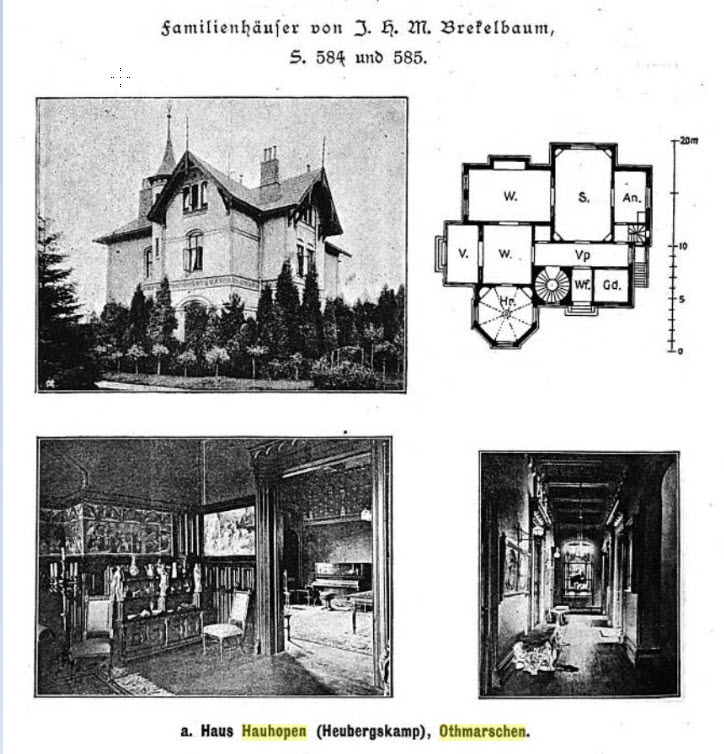
The photo on the bottom left depicts the final segment
of the fresco-cycle.
(Panels 10 and 11, see Bild 4 below).
|
|
|
|
|
Julius Naue
"The Fate of the Gods from the German Hero-Saga"
A Fresco-Cycle
THE LOST MASTERPIECE
Panoramic
View
(click here) |
|
An image of the final section of
the fresco-cycle (corresponding to Bild 4 below)
can be seen in this photograph of
the Great Room.
 |
|
From the single identifiable photo, of the end of the
frieze, it looks like the whole cycle is along one wall
of a walk-through room, with at least one depressed
alcove as seen in the picture.
The principal painting(s) is the fresco-cycle itself.
Additional figures and scenes painted in the
flourishes above it accompany those
depicted in the main
panels. The work contained 11 painted panels, as well as
companion pieces in the lunettes (stichkappe) and
spandrels (zwickels) above each scene. The scenes
progress
from the early days to Ragnarök, invoking images from
the eddic poem Völuspá.
The initial image
in the Halbrund ("half-circle") depicts the three Norns seated: Verdandi
writing on a golden shield, Urd looking back and holding
fast what has been written, and on the right Skuld, the
youngest, holding the unwritten shield close to herself.
Of this set, only a single
sketch of Verdandi is known to survive (see below).
The following
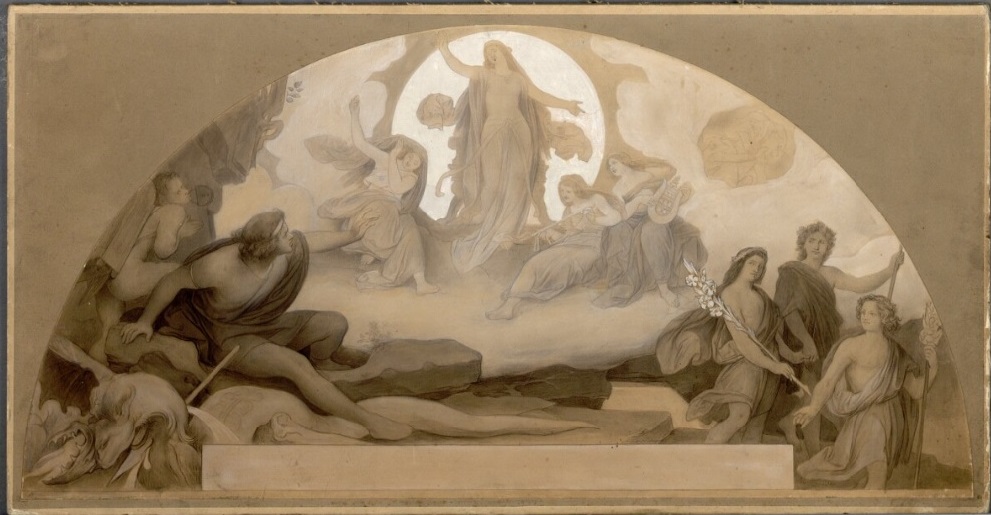
illustration is an example of a Halbrund created by
Naue's mentor Moritiz von Schwind. In the same style
for a different product. In Naue's fresco-cycle, an
illustration of the three Norns on a Halbrund marked the beginning and end, moving from left
to the right. The Halbrund may have been over the
opposite doorway or a fresco to the right of the door,
which introduces the fresco-cycle, similar to the
painting to the left of the doorway pictured above, at
the end of the frieze, which may conclude it.
|
|
Example of a Halbrund
from Mortiz von Schwind's The Queen
of the Night
|
|
The single known surviving
sketch for the Halbrund featuring the three
Norns:
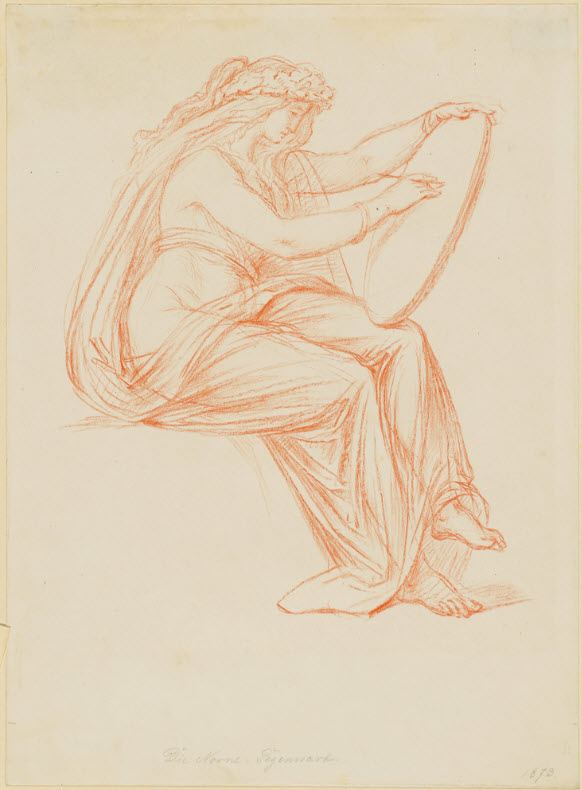
1873
Julius Naue
The Norn: Present Day (Verdandi)
Lenbachhaus Digital Collection |
German Mythology and Its Use
in Art and Poetry
by Dr. Paul Herrmanowski 1891.
Volume 2, 1891, p. 16 ff.
Chapter 6. Naue's
Pictorial-Cycle "The Fate of the Gods" from the
Edda.
There are no known images of the first segment of the work.
|
|
I. The frieze itself begins on the left
with a painting of Hel. The mistress of the underworld
sits before the cave entrance in dark clothing, with a
grim face, as though greedily awaiting the arrival of
new silent guests. Ash‑urns and her staff stand to her
left, and somewhat higher up, on a stone, the soot‑brown
cock.
II. The next picture to the right shows the
Æsir in the joyful, harmless time of innocence, when
they lived without constraint and without longing for
unattainable goods. They played cheerful games on the
Ida‑field (Idafeld) and tossed dice and disks for
amusement. In the painting we now see how the gods watch
the ball‑game of their favorite, the beautiful Baldr. To
the right of Odin, who occupies roughly the center of
the group, sits Thor with red hair and beard. Loki, who
sits at the far left, is clearly not watching the game
with eye or thought. He listens and looks tensely into
the distance, from where three giantesses—the three
sisters of fate—approach with an evil gift: gold. Naue
shows them bringing this treacherous metal, and with it
guilt and ruin, even among the gods.
III. In the next painting, the Æsir stand worried and
anxious before the uncanny gift that Verdandi spreads
out before them. But Odur (Óðr), who dwells among the
gods because he has become Freyja’s husband, looks with
greed toward the shining treasure. Loki stirs this in
him even more.
|
|
Examples of illuminated Lunettes (Stichkappen) and
Spandrels (Zwickeln):
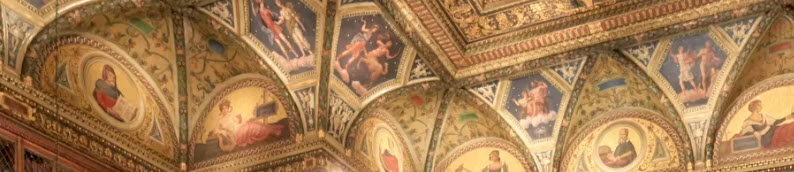
A lunette is a half-moon or
crescent-shaped architectural opening or wall space.
A spandrel is the roughly triangular space framed
between the curve of one arch and an adjacent arch.
|
|
Above the frieze, as
already mentioned, smaller pictures are painted in the
lunettes and spandrels, which further explain and
supplement the events depicted in the larger paintings
of the frieze.
The first lunette to the left
above the image of Hel shows “Night,” yet not riding
over the earth in a wagon, but as a half‑veiled female
figure in a seated posture, lifting the shrouding
garment over her head.
Then, in the spandrel, follows
“Saga,” like “Night”, depicted as youthful, with
a flowing veil, the scroll laid over her right leg,
which rests upon the left, and writing upon it with the
stylus in her right hand.
The next lunette shows
“the Old Woman in the Ironwood,” as she feeds Fenrir’s
brood. The gods had indeed bound the wolf Fenrir, but
they forgot to kill his offspring, the wolves Sköll and
Hati, whom a giantess bore him in Ironwood (Eisenwalde)
and raised there, to one day devour sun and moon.
Greedily the two ravenous creatures consume the bones
which the old woman thrusts into their jaws.
On the following spandrel, which is
above the second painting, we see Frigg, Odin’s wife.
She has golden‑blond hair. In her right hand she carries
the scepter; a necklace adorns her neck.
The next lunette, we find Frigg depicted
with her foremost attendant Fulla. She keeps the
goddess’s jewelry‑casket and is responsible for her
footwear. Thus here she is shown kneeling, busying
herself with one of her mistress’s feet.
|
|
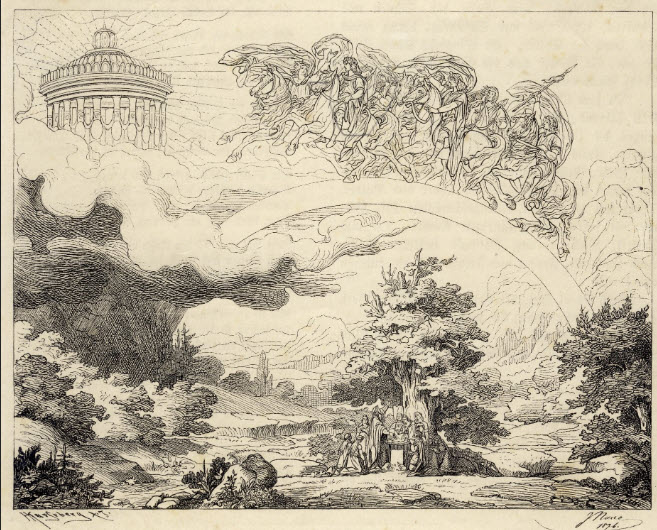
1876 Julius Naue
Der Zug nach Walhalla / The Procession to Valhalla
in the Deutsches Märchen- und Wesersagenmuseum
|
|
The next
lunette shows Mimir with his sons. He sits at the
spring of primordial wisdom and increases his knowledge
by drinking the sacred water daily. Even Odin came to
him and gave him one of his eyes as a pledge, so that he
too might drink from the spring of wisdom. From the
sickle‑shaped horn (Horne) with which he is accustomed
to draw water, he is shown drinking at this moment in
the painting, while his three sons, lifting themselves
half out of the water, their heads wreathed with
reed‑leaves, surround him.
Now follows in the spandrel “Holda, the
Spinner.” In the North, in Sweden, Frigg — the goddess
of marriage and hearth — is also the teacher and
protectress of spinning. Even today, in popular speech,
the three stars that form the belt of the constellation
Orion are called “Frigg’s Distaff” (Friggs Rocken). In
central Germany the goddess is called Holda or Frau
Holle. In the painting she draws the thread from the
distaff with her left hand, while holding the spindle in
her right.
In the next spandrel “Holda, the Protectress
of the Unborn” is depicted. A number of small beings
wriggle on her lap, and a large cloth, which she holds
flowing over her head, is meant to protect the little
ones at the same time. She was precisely the guardian of
children not yet born or those who died early, whom she
tends and mothers in the depths of wells and lakes,
where she has gardens and meadows. Even
today one hears of children’s wells and lakes, from
which the stork — or in Low German Adebar, i.e.
“child‑bringer” — fetches the children’s souls so that
they may enter the world of bodies. Holda likes to dwell
in wells and lakes.
And so Naue shows us in the
next spandrel; “Holda descending to bathe.” No garment
covers her limbs, but, in the fashion of his teacher
Moritz Schwind, her golden‑yellow hair falls almost to
her feet down her back, so that she can nearly wrap
herself in it. She likes to comb it after bathing.
Between the first and second spandrel
image of Holda, the lunette depicts how “the sleeping
Thor has his hammer stolen by the giant.” On the left we
see Thor and his wife Sif slumbering, while on the right
the giant Thrym, the dreaded hammer in his right hand,
mockingly waves farewell to the pair with the other.
Naturally Thor — and with him all the Æsir — is
horrified and dismayed the next morning. If this
terrible weapon is missing, they will soon be powerless
against the giants.
Loki, equipped with Freyja’s falcon‑cloak,
discovers the thief, who admits to him in Jötunheim
without hesitation that he stole the hammer — and, to
Loki’s inner delight (for he wishes only harm to the
Æsir), adds that he will return it only on the condition
that the gods give him Freyja as his wife. “Loki with
the Giant” is therefore the designation of this next
lunette.
|
|
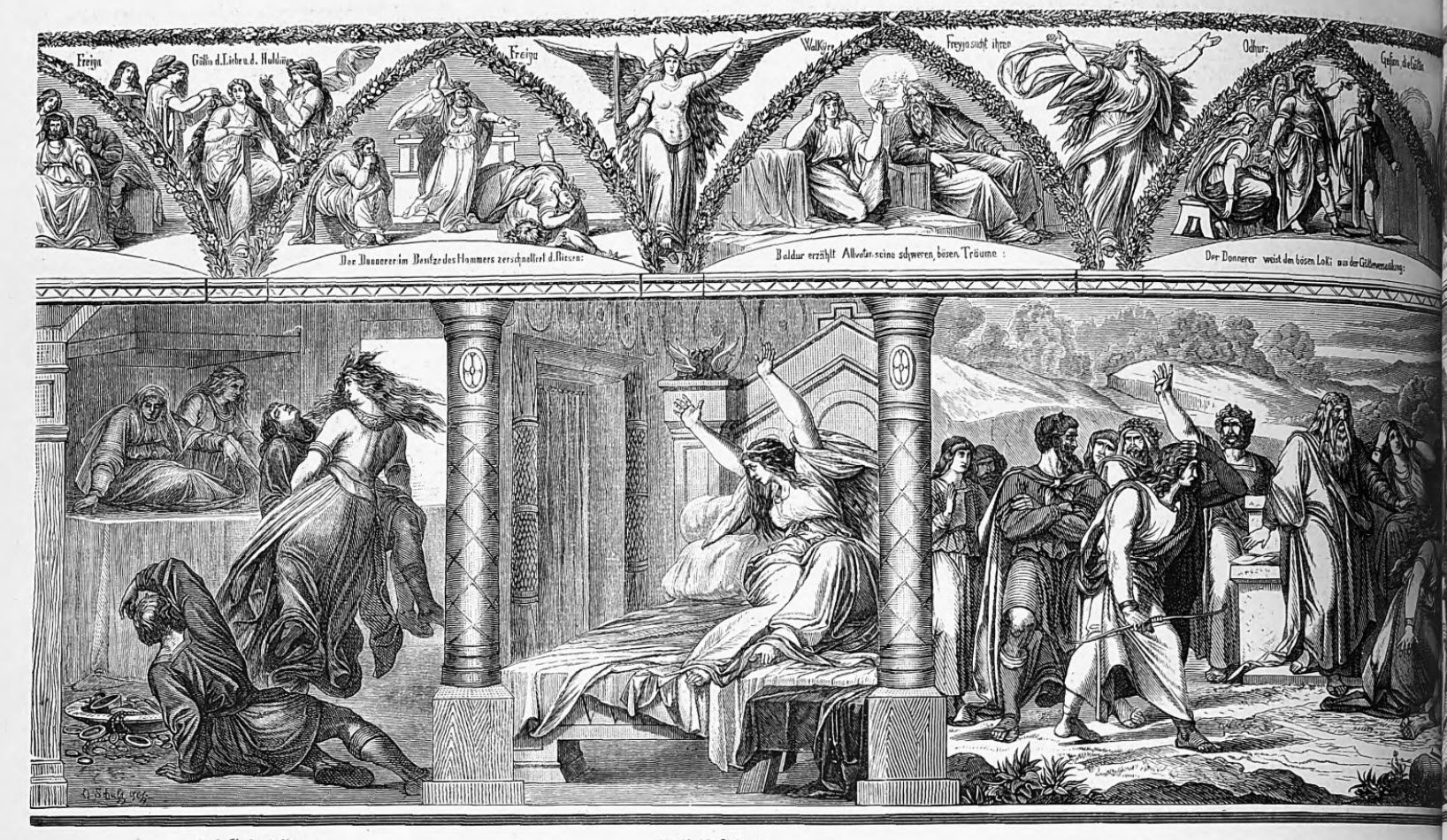
Four Newspaper Sketches of the Fresco-Cycle
Illustrirte Zeitung bd.74, nr. 1918, 1880, pp.
283-286
The Ilustrated Newspaper,
no. 1918, 1880
Panoramic
View
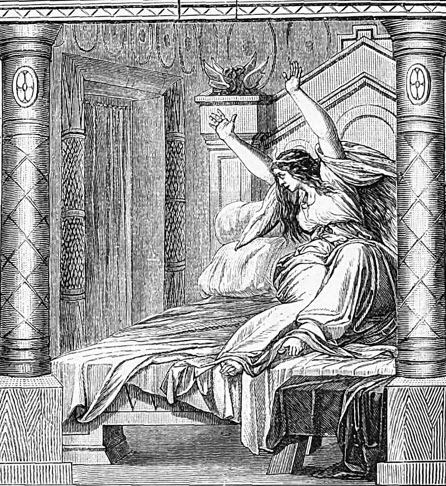
Julius Naue 1877
Panel 5: Freyja Wakes to Find Odur
Missing
The Ilustrated Newspaper, 1880,
Bild 1.
|
The first sketch is a continuation of the one before,
which suggests that Karl Albert Regnet, drew the entire
fresco-cycle, but only the latter half was published.
The description of the fresco-cycle by
Dr. Paul Herrmanowski (1891)
continues. From here, we can match images to the text. |
|
|
The following
lunette (right half only shown here) now shows how Thor is adorned by the gods and
goddesses with Freyja’s garments in bridal fashion. For
since Freyja most decisively refuses to become the
giant’s wife, Thor resolves to go to Thrym himself,
disguised as Freyja. Loki accompanies him as a maid.
(Top left, cut in half)
In the spandrel between these two lunettes the
goddess concerned in these scenes is depicted — namely
“Freyja, the Goddess of Love, and her Attendants.” Three
maidens stand busily around the seated mistress. The one
to her left is in the act of placing the radiant
necklace Brisingamen around her neck; one to her right
arranges her hair; and behind this maiden stands a
third, holding a bowl aloft.
In the next lunette, Thor, dressed as a bride,
recovers his hammer and slays the giants at Thrym's.
In the next spandrel follows “Freyja as leader of the
Valkyries,” fully armed. A byrnie covers her breast. In
her right hand she holds the sword high; a helmet covers
her head, and the falcon‑wings are spread on either side
of her back.
In the next lunette we see Baldr, in bright
garments, sunk down beside Odin, supporting his
thoughtful head with his left hand and with his right
pointing upward, as if toward the dreams that have
troubled him for some time. “He tells them to Odin,” and
Odin seems to calm and comfort him.
In the spandrel that follows we find Freyja, hands
raised in lament, floating through all the worlds in
search of her lost husband Odur.
The title of the next lunette is "Thor drives the evil Loki away at
Ægir’s”. At the most recent drinking‑feast at Ægir’s —
he gave the gods a meal each year — Loki insulted every
single one of the Æsir, heaping guilt and shame upon
them, until Thor arrived and threateningly drove the
venomous slanderer away.
|
|
 |
|
IV.
Odur now attempts, together with Loki, to steal the
treasure from the Norns, but Skuld catches him and leads
him away — while Loki falls to the ground — so that he
may atone for his transgression. This is the subject of
the fourth painting.
V. Odur had chosen the night for his
undertaking. Early in the morning, when Freyja awakens,
she finds her husband’s place empty, and — as the next
painting shows — she lifts her hands above her head and
couch in lamentation.
VI. Loki, the evil one,
broods on further misdeeds. The most beloved and lovely
of the Æsir is Baldr. Innocent and pure is his nature.
And yet he was to be the first of the gods to fall.
Heavy dreams trouble him: he will soon die. So his
mother Frigg takes oaths from all things and beings not
to harm her son. Only a small mistletoe shoot, which
grew on an old oak, she did not bind by oath, thinking
it too young and too weak. Loki learned of this. Now,
when the gods, as a test, shoot at Baldr with all manner
of things — even with spears — and he, to their joy,
always remains unharmed, Loki hands Baldr’s brother, the
blind but strong Hödur (whom Frigg likewise bore to
Odin), the mistletoe twig, which Loki in the meantime
had made strong as a spear through his magic, and urges
him also to do honor to his brother, as all do, and to
shoot at him. He shows him the direction, and Baldr,
struck fatally, sinks to the ground — as the sixth
painting shows — the arrow in his heart. His wife Nanna
collapses, torn with grief, over his body. Frigg,
horrified, tears her hair. Gods and goddesses lament,
and Thor raises his hand threateningly against Loki,
(Continued into Bild 3, the next illustration)
|
|

Panel VI: Baldurs Death
Image sold at
auction 2016 |
|
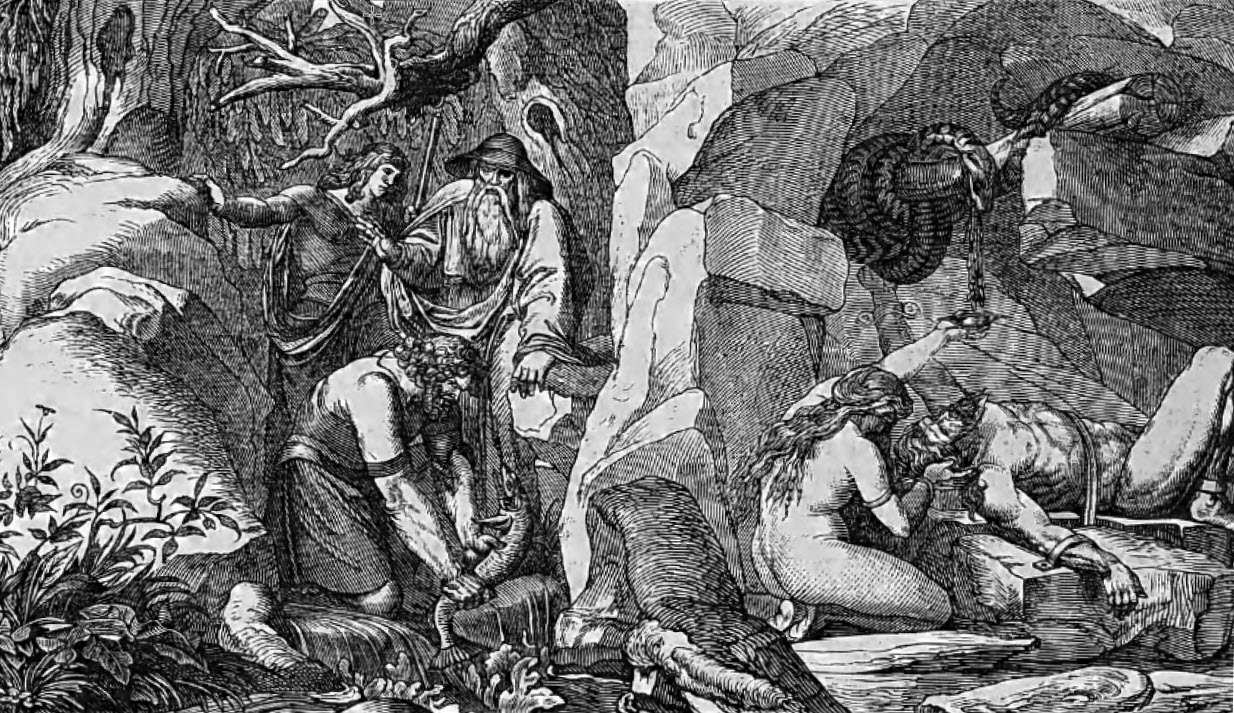
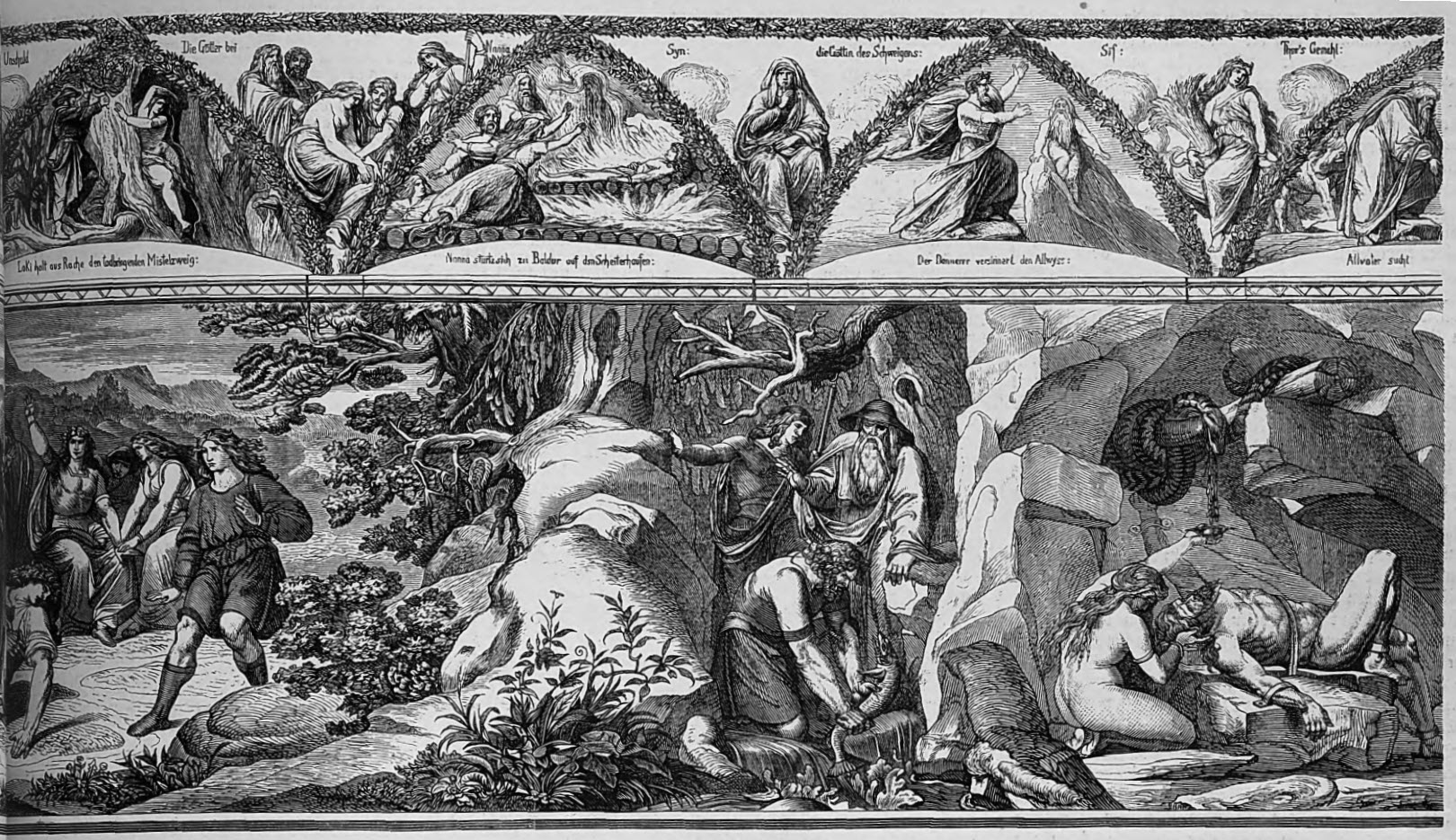
Julius Naue 1877
Panels 7 and 8: Loki's Capture and
Binding
The Illustrated Newspaper,
1880, Bild 2:
|
|
|
|
|
Brooding on revenge and mischief,
Loki now fetches — as we see in the next lunette —
the mistletoe twig, Baldr’s destroyer.
But all comfort is in vain. The
following lunette shows how Nanna, when the funeral
pyre is built and Baldr laid upon it, throws herself
into the flames.
In the next spandrel we see “Syn, the
goddess of silence.” She wears a long garment and has a
cloth drawn over her head. She holds the index finger of
her right hand before her mouth as a sign of silence. A
large key, which the seated figure holds over her lap
with her left hand, signifies what is shut and sealed.
At the same time it indicates that she guards the doors
of the gods’ hall and closes them to those who should
not enter.
In the following lunette is depicted “how Thor, at
sunrise, turns the dwarf Alvis to stone.” In the
painting one sees the dwarf’s head and beard and upper
body stiffening, while the lower part has already become
stone.
In the next spandrel Sif,
Thor’s wife, appears as “goddess of the harvest.” She
holds a sickle in her left hand and a sheaf of grain in
her right.
The following lunette shows
Odin at Mimir. Restless because of Baldr’s death and
because of Loki’s captivity — Loki, his former
blood‑brother — Odin, sensing the nearness of Ragnarök,
rides to the wise Mimir to consult with him. His
stallion Sleipnir paws the ground impatiently as Odin
bends toward Mimir while speaking, Mimir rising from the
spring. Reeds wreathes his head, and a water‑colored
bluish beard flows deep down his breast.
|
|
 |
|
VI. The Death of
Balder, continued from previous illustration.
VII. Loki flees, full of malicious glee.
But Odin, Thor, and Heimdall pursue him. At a secluded
waterfall they find him. Yet as a salmon he slips from
them into the waters. Here, however, Thor seizes him and
holds him fast despite all his twisting and struggling.
This is illustrated in the seventh painting.
VIII. The following painting shows Loki’s
punishment. Bound to a rock‑piece, he lies there in his
true form, above him the venom‑dripping serpent, while
beside his head his wife Sigyn kneels, holding a bowl
over his face to catch the drops of poison. Thus he lies
until the twilight of the gods.
|
|
In the next
spandrel we see “Skadi, Njord’s wife, who goes far from
her husband into the ice‑mountains, skating and
hunting.” She holds a throwing‑spear in her hand. In
Asgard she won Njord as her husband, the god of the
gentle, summer sea. But in his dwelling Noatun by the
seashore, where the gulls cried and the swans sang so
that she could not sleep for the birds’ noise, she felt
ill at ease — and he likewise in her home Thrymheim,
where ice‑mountains towered and wolves howled.
The god of the wild sea is Ægir, and he is shown
in the following lunette. He is depicted as an old
man. Beside him sits his wife Ran. Both wear diadems and
reeds in their hair. Ægir holds, like Poseidon, the
trident in his right hand. On either side two of their
daughters recline, naked in contrast to their parents,
but also with reeds wreathing their heads.
|
|
Julius Naue 1877
Original Sketch of the Aegir and
Ran Lunette
Lenbachhaus Digital Collection
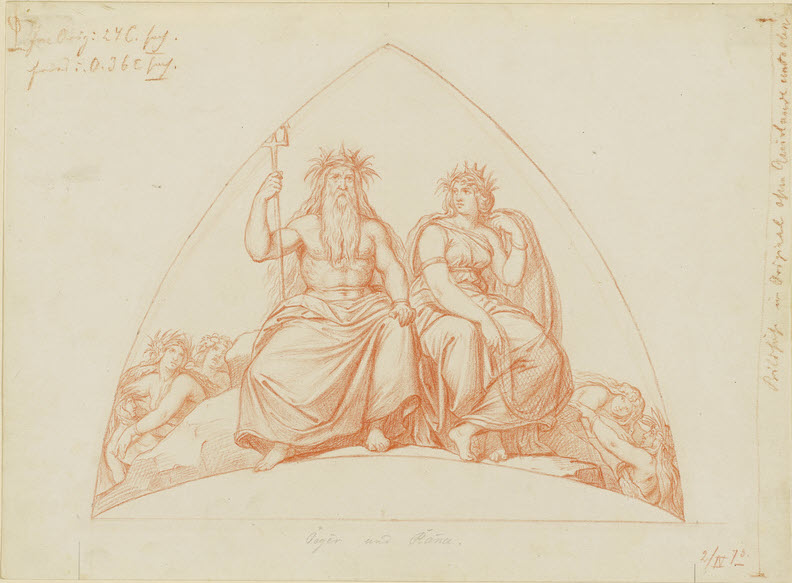
Öegir und Rana
|
|

Julius Naue 1877
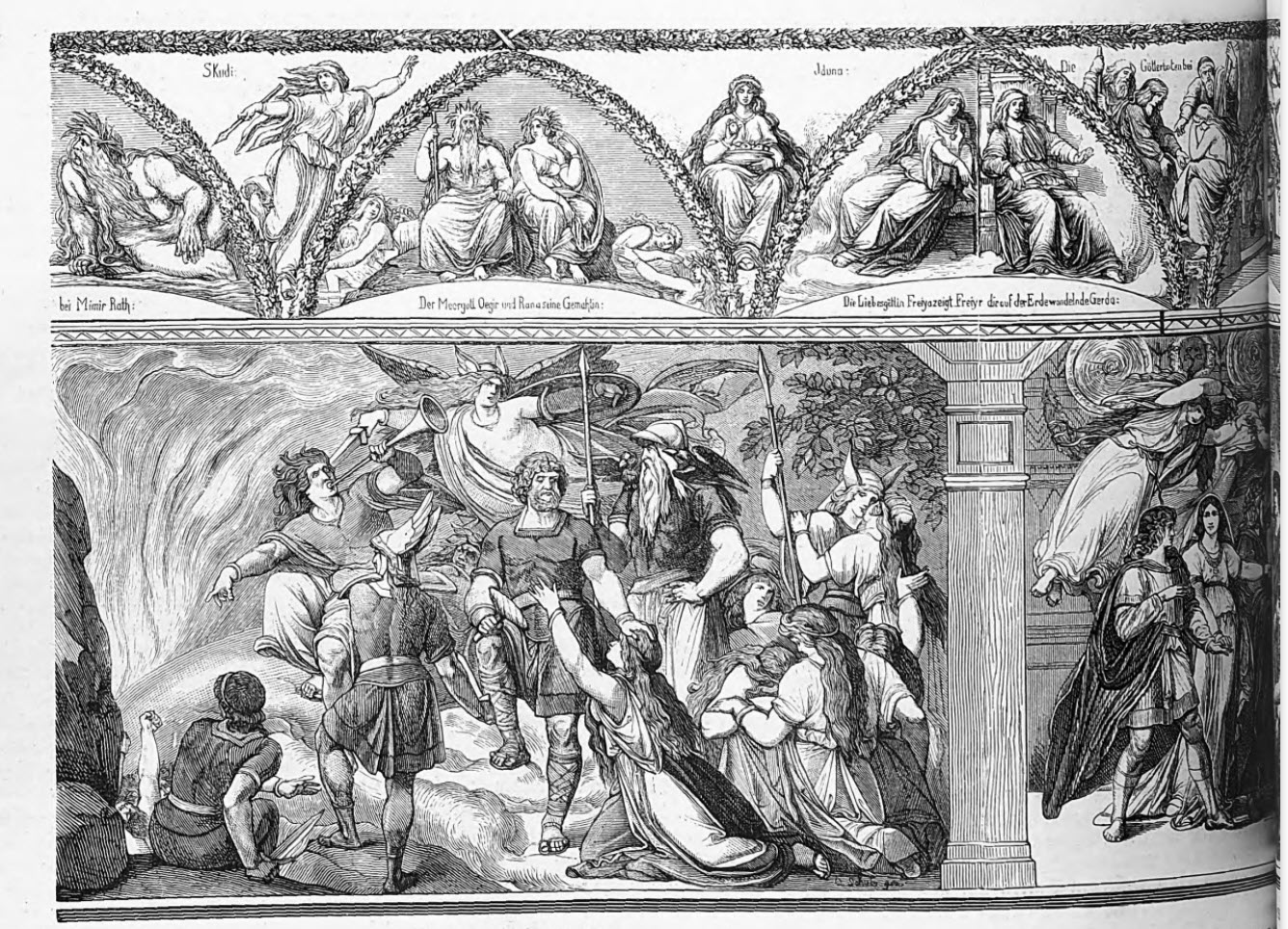
Panel 9: The Aesir Prepare for their Final
Battle.
The Illustrated Newspaper, 1880, Bild 3:
|
|
In the next spandrel
we see Idun, the goddess of unfading youth, holding on
her lap the bowl of rejuvenating apples, one of which
she has taken out with her right hand. A wreath of
flowers adorns her head, from which her hair hangs long
down on both sides.
To the fair light‑god Freyr,
who has seated himself on Odin’s high‑seat, his sister
Freyja, the goddess of love, shows the radiant Gerda —
this is the theme of the following lunette. Gerda was
the daughter of the giant Gymir, a dazzlingly beautiful
maiden. Freyr saw her when he once sat upon Odin’s
high‑seat Hlidskialf, from which all worlds can be
surveyed. She walked in Giant‑home (Jötunheim). Air and water shone
back from her white arms.
The next spandrel depicts how the three divine
messengers Heimdall, Bragi, and Loki attempt to persuade
Idun — who shortly before Ragnarök had sunk from the
bright heights into the cold depths of night, the
companion of Hel — to return to the gods. She sits
there sorrowfully supporting her head in her left hand.
Heimdall bends down toward her, stretching both hands
out to her, as if to raise her up. Behind him stands
Bragi, a staff in his right hand, his pleading gaze
fixed upon Idun. To the right, in the background, stands
Loki, giving more emphasis to his urging with his
outstretched right hand.
By Odin’s command the messengers were also to ask
her, the all‑knowing one, what she knew of the
threatening fate of the world, and whether what had
befallen her meant doom for the world and the gods. But
she gives no answer. Only tear upon tear flowed from her
clouded eyes. Timid and as if stunned the poor goddess
appears to the messengers. The two others return to
Asgard without success, but Bragi remains behind with
his wife to comfort her. [This is a
summary of the plot of the eddic poem
Hrafnagaldr Odins]. |
|
|
|
|
 |
|
IX. In the next painting
the Æsir arm themselves
for their final battle. Heimdall, seated on the
rainbow‑bridge, hears the soot‑brown cock’s cry and
blows the Gjallarhorn with all his might. His red‑yellow
hair flutters wildly around his uncovered head. With one
hand he points downward, where giants already storm
toward the gods’ fortress with raised fists. Close
beside him stands Tyr, the youthful god of war; he
grasps his sword more firmly. Next to him, foremost
against the giants, sits Vidar, Odin’s avenger. Above
Heimdall, Freyja — equipped with shield and falcon‑cloak
— flashes her sword, as though, like a Valkyrie,
floating ahead into battle. Directly beneath her stands
Thor, the strength‑belt around his loins, the hammer in
his iron‑shod right hand, his left laid comfortingly on
the head of his wife Sif, who, filled with pain and dark
foreboding, has sunk to her knees. Behind Thor stands
Odin, towering above him and all others, holding the
spear Gungnir upright in his hand. A helmet covers his
white head, and his two ravens sit upon his shoulders.
To his left kneels Frigg, quietly composed. In her lap
Gefion hides her head. In the background Freyr —
likewise armed with helmet and spear — takes leave of
his wife Gerda, the white‑armed daughter of the giant
Gymir, as she lovingly clings to him.
X. “The Blessed Gods’ Reunion in Valhalla” is the
title of the last great ensemble‑painting on the frieze, The
monsters have been cast down forever; the gods are again
joyful and cheerful, as once before in the time of
harmless innocence, in their fortress. Led by Freyja’s
hand, Odur also enters, who has paid dearly for his
transgression. Bragi, the god of poetry, brings Idun —
who at the approach of Ragnarök had sunk into the dark
depths of night — back to the gods with the golden
apples. Garlands surround Bragi’s aged head as well as
Idun’s lovely brow. Baldr, who kneels before Idun,
receives first — at Nanna’s request, who is beside him —
the rejuvenating gift from the goddess’s hand. Freyr and
Gerda, who stand foremost, greet the arriving ones with
great joy, as do Sif and Tyr, who stands behind her in
the background. Also Ægir the Old, who has
comfortably taken his place at the table, looks
benevolently toward them, as does the heaven‑queen
Frigg, now adorned with a crown, and Vidar, who points
out the entering ones to her. (Continued, next
illustration).
|
|
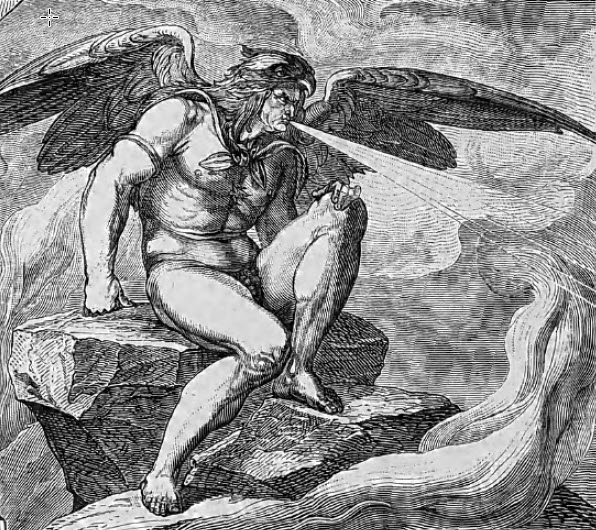
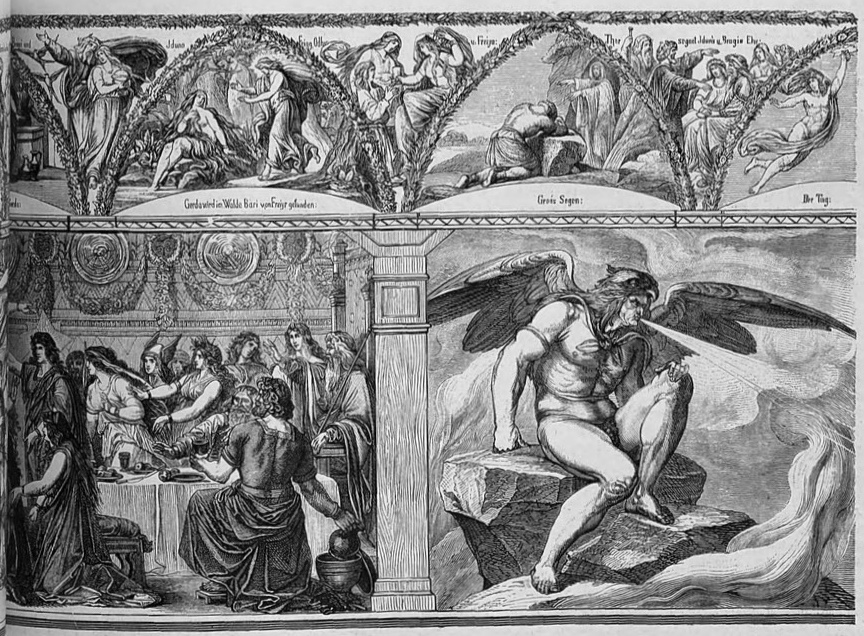
Julius Naue 1877
Panel 11: The Wind, Hræsvelgr,
blows
storm‑wind over the earth
The
Illustrated Newspaper, 1880, Bild 4:
|
|
In the
next spandrel, Bragi floats upward with Idun, who is
joyful again and holds the vessel of apples, ascending
to the Æsir like the two swallows flying beside them,
announcing and bringing a new spring to the gods.
In the following lunette,
we indeed see the dazzlingly white Gerda, naked, only
surrounded by her long golden‑yellow hair, sitting by a
body of water, one foot hanging down into it, turning
toward Freyr, who approaches from the right, hands
outstretched longingly toward her, wrapped in red
garments and his head encircled by golden light.
The next spandrel
likewise shows reconciliation and joy: “Frigg leads the
veiled Freyja to Odur, who has completed his penance.”
Joyfully Freyja unveils herself and hands the
long‑sought husband, who kneels before her, the
welcome‑cup.
The following lunette contains
Groa’s blessing. The seeress has summoned her son to
death's door. He calls her forth, and she now speaks
nine words of healing over him. Her figure and face are
partly veiled. Blessing him, she spreads her hands over
her son, who has sunk down before her and bows his head
upon his hands, which he has crossed upon a stone.
The spandrel after this also depicts a blessing:
“Thor blesses Idun’s and Bragi’s marriage.” The two are
festively crowned, and Thor’s hammer lies upon Idun’s
lap for consecration. Over the couple sitting
before him Thor raises his hands in blessing. Behind
Thor stands Odin; behind the couple stand two goddesses.
The conclusion of the entire
upper section corresponds to the opening image, which
showed “Night”: now the lunette “Day,” depicted as a
youth with a flaming torch in his hand, fluttered about
by a reddish garment‑cloth.
|
|
 |
|
|
|
|
X. "The Blessed Gods’ Reunion in Valhalla”
(Continued from previous illustration).
Odin, who bears the scepter, welcomes them kindly from
his high‑seat at the upper end of the table, while Thor,
who sits opposite Ægir, intends to consecrate a
welcoming drink for them with the cup in his hand. His
left hand lifts the cup high, his right is about to draw
more liquid with a jug. Quite deliberately Naue lets
Thor not forget the drink even here. He was known as a
strong eater and drinker.
XI. Just as Hel, the daughter of the
giant‑woman Angrboda, began the frieze, so it is also
ended by the image of a giant — namely Hræsvelgr, who
sits on a rock rising into the clouds and, with his
eagle‑wings and puffed‑out cheeks, blows and wafts the
storm‑wind over the earth. Mighty and strong is the
build of his unclothed body.
|
|
|
|
|
Also known:
A single loose drawing from this set appeared in a catalog of
drawings in the Arnold Otto Meyer Collection as:
Die versammelten nordischen Götter, "The
Gathered Norse Gods". Watercolor. Height 43 cm, Width. 55 cm.
Sepia. Signed: "Rome. April 14, 1874. J. Naue", with an
explanation below "The Nordic gods thank you that Haus
Hauhofen has been given a home for them."
Thor smashes the giant's sister. All-father
counseled at Mimirs. Skirnir woos Gerd for Freyr. Gerd waits for
Freir in the forest of Bari. Two red pencil compositions for the
spandrels of the frieze "The Fate of the Gods" executed for
Arnold Otto Meyer in Hamburg.
Loki und der Riese Thrym, Holzschnitt von
Käseberg.
Thor hos König Utgards (See below)
Die
Nacht nährt den Tag (See below)
|
|
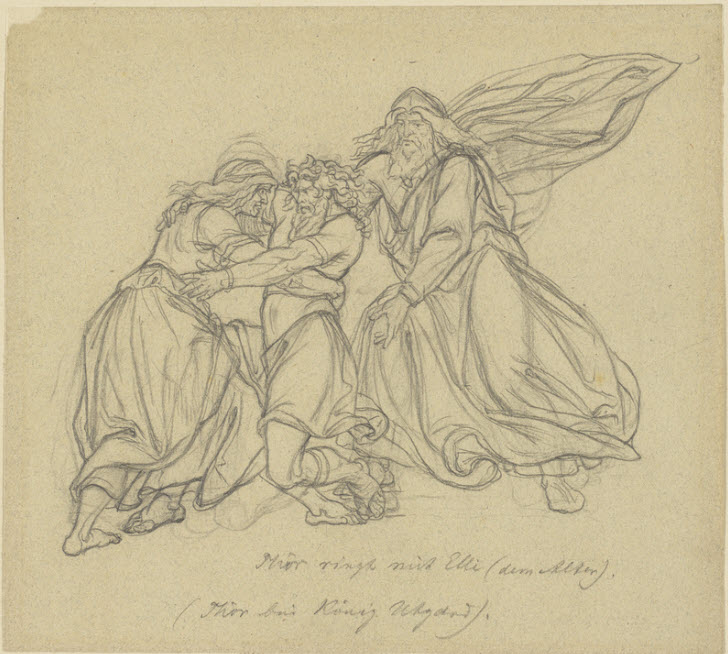
Thor hos König Utgard
Thor at the King of
Utgard's
Lenbachhaus Digital Collection
|
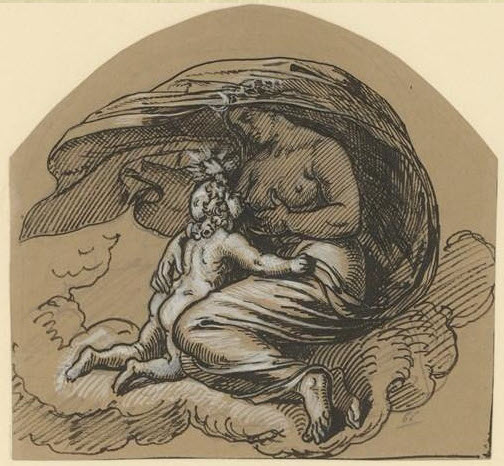
Die Nacht nährt den Tag
Night Nourishes Day
Item #517 in the 1914 Auction Book
|
|
|
One
contemporary review in Zeitschrift für bildende
Kunst vol 13, 1878, p. 341 characterizes it this
way:
|
|
"The frieze by Julius Naue of Munich, 'The Fate of the
Gods', offers rich material for a thorough study of
ancient Germanic mythology. We must joyfully welcome it
as an achievement of modern times that native traditions
are finally being brought closer to the general public.
Every step in this direction is praiseworthy. However,
for the visual arts, it seems to us of double value when
these subjects are included in the scope of artistic
representation; Greek mythology has been so frequently
exploited that—unless imbued with new vitality by an
outstanding creative spirit—it elicits little interest.
In
contrast, these Nordic sagas offer magnificent motifs
and entirely fresh inspiration for the imagination; if
interpreted and handled correctly, they will prove a
genuine enrichment to our artistic life. We may doubt,
however, whether Naue will succeed in unlocking these
treasures; for however interesting some compositions may
be, or however beautifully the figures are grouped
within the spandrels or semicircular arches, most of the
depictions are peculiar—indeed, rightly provoking more
astonishment than admiration. There are many
inaccuracies in proportion—adult figures, for instance,
appear almost like children—and the expressions are
distorted; the style is deliberately grandiose and
forceful, and consequently entirely unnatural. It is
unlikely that this meritorious work will inspire anyone
to study the Edda, or indeed elicit any lively interest
from anyone other than those who already know and love
its content." |
|
|
|
|
Panoramic View
(click here)
|